Statement on the City’s so-called class size “plan” for 2027-2028.
Media outlets that covered some of these points included the Daily News, News 12 and AMNY .
For more information: Leonie Haimson, Executive Director of Class Size Matters; leonie@classsizematters.org; 917-435-9329
The class size reduction “plan” released by DOE today is hugely disappointing and is not a real plan at all. Instead of articulating clear, multi-year strategies to attain specific reductions in class sizes as the law requires, instead the document is full of boilerplate language, repetition, and a lot of fluff. All in all, it provides no assurances to parents that Mayor Mamdani was serious about his repeated pledge when running for office that he would lower class size to provide their children with the smaller classes that they need and deserve.
The state granted the Mayor a two-year extension in return for his promise that he was serious about developing an actual real multi-year plan that would ultimately achieve the goals in the law. Yet none of this is evident in this document. Instead of describing concrete and time-specific strategies to reach the class size targets, even given the extended timeframe of two extra years, DOE admits they “hope to use the exemption process as part of the overall strategy to comply with the law.” In fact, the word exemption is used 35 times in the report.
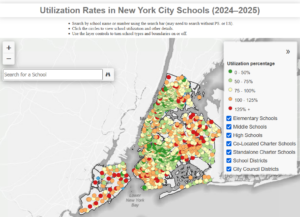
The most serious weakness in the document pertains to the lack of any real strategies to provide sufficient space for the more than 600 schools that the DOE admits do not currently have enough room to lower class sizes at their current enrollment.
The refusal to articulate an actual plan is non- compliant with the specificity required by the class size law, which states it must include the “actual class sizes for the current school year, and the projected class sizes for the upcoming school year for each school by grade level, as well as the annual capital plan for school construction and leasing to show how many classrooms will be added in each year and in which schools and districts to achieve the class size targets.”
Though the report claims that “each school with an identified space need has a clear path forward to support class size reduction efforts,” it lacks any description as to which schools will receive more space and how this will be achieved.
Instead of describing the path forward, the report instead says that the “ City is currently engaging with elected officials at the State level on a proposed SEQRA reform that would carve out public school construction projects from environmental review.” The answer to providing NYC students with the smaller classes they are entitled is not to expose them to environmental harm.
Every strategy proposed to create more space is expressed in vague and conditional language. For example, for the 133 schools in which the DOE admits more capital construction is needed, not only do they refuse to specify which schools these are and/or where new schools will be built, they do not even claim that enough seats will be added to allow them to lower class size at any point in the future. Instead, they write that the “SCA will work to identify viable solutions for these schools in accordance with available funding.”
Nowhere do they even estimate how many additional seats would be necessary to reach the goals in the law. Instead, they say they will delay releasing any updated capital plan until next November which would take into account of the additional $1.5B that the Mayor’s Executive budget allocated for this purpose.
In any case, it’s not clear that this additional funding would be sufficient. The existing capital plan has only about 33,000 seats, less than half the number that the SCA testified last year would be necessary to achieve the goals in the law. The additional $1.5B for capital construction would only create 8,300 more seats.
According to the City Council report on the Executive budget, the DOE estimated that the 4,656 extra seats that came online in Sept. 2025 increased class size compliance rates by only 1.2%. If the same ratio holds, an additional 8,300 seats would improve compliance by a little more than 2%.
In the case of the other 500 or so overcrowded schools for whom the DOE claims new construction is not necessary, the strategies they propose are even more vague and conditional. For example, in the ninety schools where the DOE says that there is available space in other school buildings nearby, there is no promise to use that space more efficiently to allow for class size reduction. Instead, the DOE vaguely asserts that “scenarios will be developed and explored that would better align existing space to demand and enrollment.”
The DOE even refuses to agree to something as simple as publicizing which underenrolled schools already have smaller classes to help attract parents to apply to those schools with the goal of lessening overcrowding elsewhere. Instead, they say this possibility will be “investigated” in future years. “NYCPS will also investigate providing additional relevant information to parents regarding class sizes at schools during the school selection process in future years.”
The report has an extended section on why they attempt to justify their decision not to align their enrollment policies with smaller classes, which would save billions of dollars and years of time. In the process, they make several misleading claims without providing any evidence to back them up.
First, they claim that reducing enrollment at high demand schools could disproportionately impact students with IEPs, Black and Hispanic students, and students living in poverty. Actually, according to our analysis, using SED’s list of schools with the highest weighted need, the schools with the largest numbers of Black, Hispanic, students in economic need are most likely to be enrolled in schools with the lowest rates of class size compliance. Reducing class sizes in these schools would thus benefit these students the most.
They also claim that reducing enrollment at high-demand schools “could lead to more families leaving NYC public schools.” Studies suggest just the opposite. When public schools in California lowered class size, research shows that this reform attracted thousands more families to the public school system. And last year, when DOE surveyed parents who had taken their kids out of the public schools, 82% said class size was a factor, and 58% said it contributed “a lot” to their decision.
Finally, DOE adds that “many families are strongly opposed to enrollment reductions, as evidenced through public engagement on the issue within the Class Size Working Group.” Yet CSWG report did propose this option and explained that more equitably balancing enrollment between nearby schools would not only help students enrolled in overcrowded schools but help those at the underenrolled schools as well and allow them to be provided with a more adequate budget with more programs and services.
This DOE document also ignores all the other strategies put forward by the CSWG report, including siting more 3K and PreK seats in nearby CBOs, that have thousands of empty seats and can offer extended day and extended year programs, invaluable to working parents, Three quarters of elementary schools too overcrowded to lower class size have 3K and/or PreK classes; shifting them could create 450 additional classrooms and save as much as $1.7 billion and years of time.
Nor does it include any of the other recommendations of the CSWG to more efficiently acquire school space, including re-starting the School Siting Task force to more quickly identify suitable sites with more community involvement ,and reviving the Educational Construction Fund created in 1967 to create new schools in mixed development projects. The CSWG report also pointed out how schools could be incorporated in the planning process for new housing where they can serve as anchor tenants and help with financing. Instead, new high rises are being built in many neighborhoods where the schools are already overcrowded and only likely to become more so in the future.
###
Social Networks: